
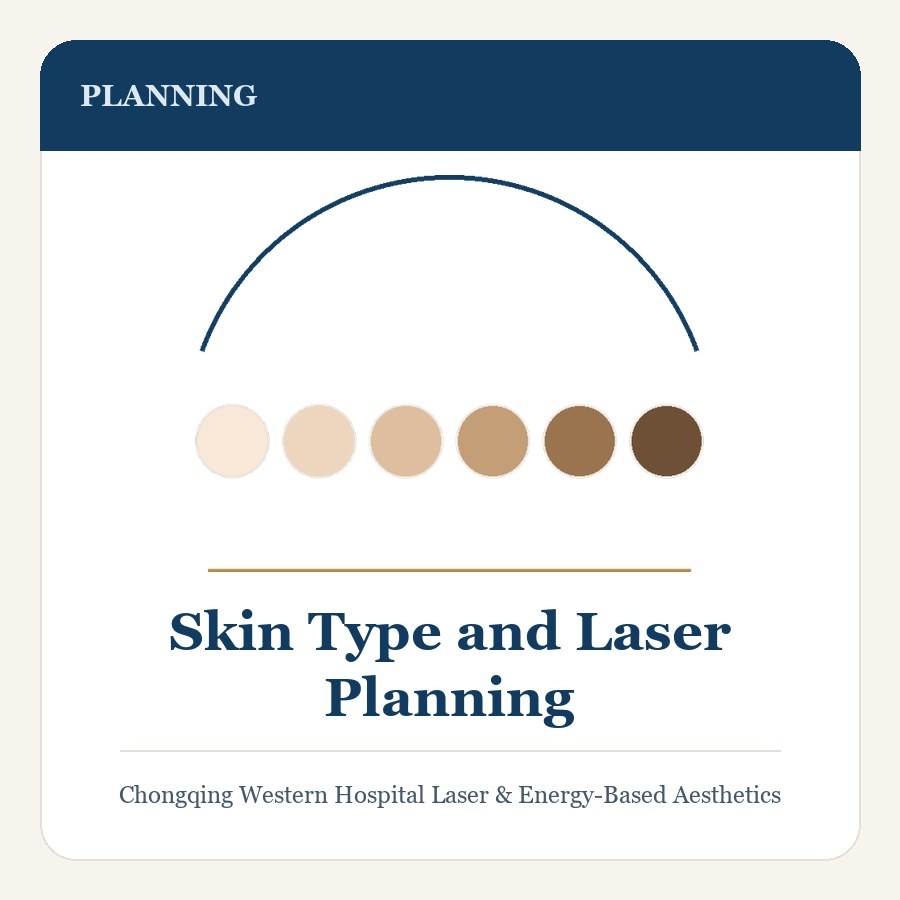
In short. The Fitzpatrick scale explained, why melanin competes with every laser target, and how skin type changes wavelength, settings, intervals, and risk.
Key points
- The Fitzpatrick type of the face, neck, and body may differ, and it changes with sun exposure and with recent tanning.
- A patient who returns from a beach holiday is, for planning purposes, a different patient, which is why sun exposure before treatment is asked about and why treatment may be postponed.
Laser planning begins with a question that has nothing to do with the device: how much melanin is in this skin, and how does it behave? Two patients asking for the same treatment can need different wavelengths, different settings, and different numbers of sessions purely because their skin pigment differs.
The Fitzpatrick scale, plainly
The Fitzpatrick scale classifies skin by how it responds to sun exposure rather than by appearance alone. Type I burns easily and never tans; type II usually burns and tans minimally; type III sometimes burns and tans gradually; type IV rarely burns and tans readily; type V rarely burns and tans deeply; type VI never burns and is deeply pigmented. The scale is a shorthand for melanin activity, and it is imperfect: it was devised for fair skin, and Chinese skin tones commonly fall between types three and four, where the distinction between burning and tanning is subtle and personal history matters more than the number.
Why melanin complicates everything
Melanin absorbs light across a wide range of wavelengths, including most of those used to treat pigment, vessels, and hair. In lighter skin the target absorbs much more strongly than the surrounding skin, giving a wide margin between a therapeutic dose and an injurious one. In darker skin that margin narrows, and every adjustment aims at preserving it: longer wavelengths that melanin absorbs less, longer pulses that let epidermal heat dissipate, lower energy density, and more aggressive surface cooling.
What changes in practice
Darker skin types are planned with fewer passes, lower settings, more cooling, and longer intervals between sessions, and a test spot moves from good practice to a requirement. Hair removal needs particular care, since the follicle and the surrounding epidermis compete for the same light. Post-inflammatory hyperpigmentation — darkening of the treated area — is the most common adverse outcome, and it becomes far more likely when settings are borrowed from a protocol designed for lighter skin.
Skin type is not a single number
The Fitzpatrick type of the face, neck, and body may differ, and it changes with sun exposure and with recent tanning. A patient who returns from a beach holiday is, for planning purposes, a different patient, which is why sun exposure before treatment is asked about and why treatment may be postponed.
Recording and revisiting
Skin type should be documented at the first visit, along with any history of pigment change after injury, scarring, or previous laser treatment, and it should be reviewed before each session. A safe plan today is a plan designed for the skin in front of you today, and it is often a more conservative version of what the same concern would justify on lighter skin.
Higher-risk situations
- A darker skin type or a recent tan is treated with the same settings used on lighter skin, without adjustment or a test spot.
- You have previously developed darkening, lightening, or scarring after a laser session or after a skin injury, and nobody has asked about it.
- Treatment is planned on tanned skin, or immediately before a holiday with strong sun exposure.
Frequently asked questions
What is the Fitzpatrick scale for?
It classifies skin by how it responds to sun exposure rather than by appearance alone, from type one, which burns easily and never tans, to type six, which never burns and is deeply pigmented. It is a shorthand for melanin activity, and it is imperfect.
Why does melanin complicate laser planning?
Because melanin absorbs light across a wide range of wavelengths, including most used to treat pigment, vessels, and hair. In lighter skin the margin between a therapeutic dose and an injurious one is wide; in darker skin it narrows, and every adjustment aims at preserving it.
How does skin type change the treatment plan?
Darker skin types are planned with fewer passes, lower settings, more cooling, and longer intervals, and a test spot becomes a requirement rather than good practice. Hair removal needs particular care, since the follicle and the surrounding epidermis compete for the same light.
Risks & Limitations
- Burns and blistering if settings do not match the skin.
- Post-inflammatory hyperpigmentation, particularly in darker skin types, which may take months to settle.
- Hypopigmentation (lightening) of treated skin, which can be permanent.
- Scarring, including hypertrophic scarring, which is uncommon but real.
- Infection, including reactivation of herpes simplex after resurfacing.
- Acne or milia flare during recovery.
- Results are incremental and most concerns need several sessions. Melasma may rebound or worsen with aggressive treatment.
When to Seek Care
- Blistering, weeping or broken skin beyond the expected reaction.
- Severe pain that is worsening rather than settling.
- Spreading redness, warmth, pus or fever.
- New darkening or firmness that looks like scarring at the treated area.
- Any change in a treated pigmented lesion — it should be reviewed, not retreated.
References & Further Reading
- American Academy of Dermatology (AAD) — laser and energy device information
- American Society for Laser Medicine & Surgery (ASLMS)
- National Medical Products Administration (NMPA, China) — device registration status
- Cochrane Library — systematic reviews in laser dermatology
This page is patient education, not medical advice, and it does not cite individual studies. Discuss your own case with a qualified clinician. To arrange an assessment at Chongqing West District Hospital, see Contact & Consultation.