
In short. Ablative and non-ablative fractional resurfacing explained, with honest expectations for healing time, redness, pigmentation risk, and who should avoid it.
Key points
- Post-inflammatory hyperpigmentation after resurfacing is common, particularly in darker skin types and after sun exposure during healing.
- It is usually temporary but can take months to settle.
- A history of cold sores requires antiviral cover, since resurfacing can reactivate the virus.
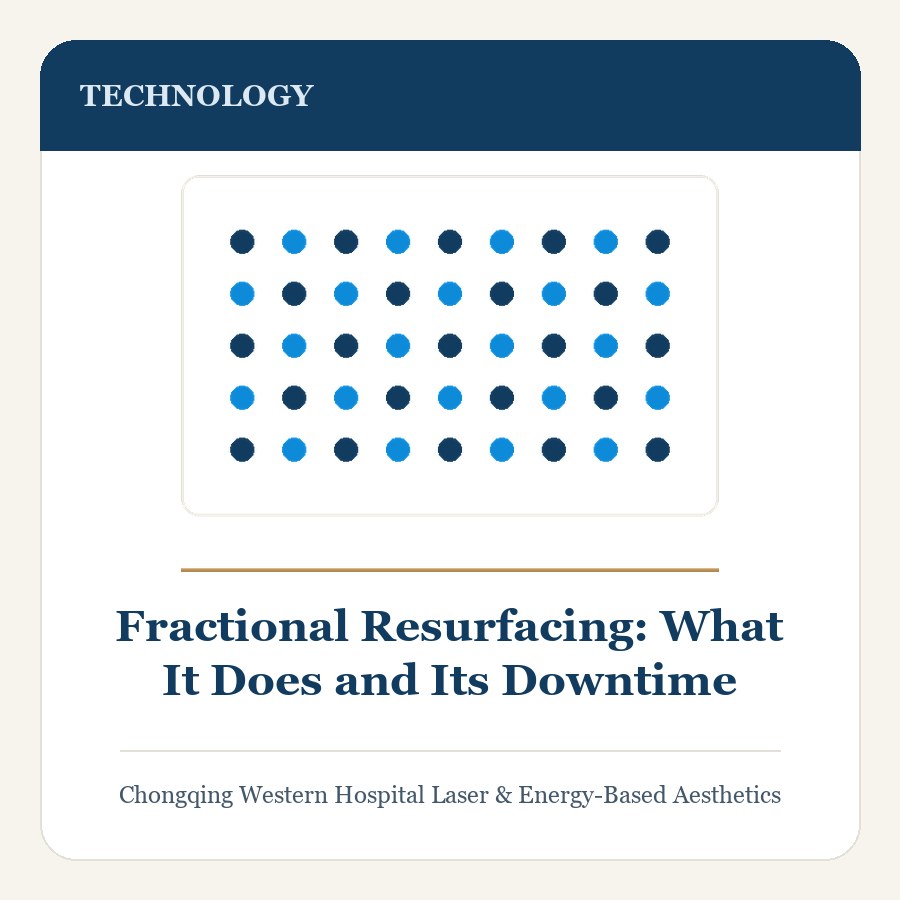
Fractional resurfacing treats skin in a pattern of tiny columns rather than as a solid sheet. Between the columns, normal skin is left intact, which is what allows the skin to heal faster than full-surface resurfacing would permit. It is a genuinely useful technology, and it is also the one most often described with unrealistic claims about downtime.
Ablative and non-ablative
Ablative fractional devices, using mid-infrared wavelengths strongly absorbed by water, remove the surface layer within each column and produce a visible wound that heals over roughly five to seven days. They produce the most substantial change in texture, sun damage, and some scarring, and they cost the most healing. Non-ablative fractional devices, using near-infrared wavelengths, heat tissue in the same column pattern without removing the surface, so healing is shorter — often one to three days of redness and mild swelling — but the effect per session is more modest and more sessions are needed.
What actually improves
Fractional resurfacing works by injuring tissue in a controlled way, prompting a wound-healing response that lays down new collagen and remodels existing collagen over the following months. That is why results continue to develop for three to six months after a session, and why judging the outcome immediately is misleading. The concerns it addresses most convincingly are sun-related texture and tone, fine lines, and certain acne scars. It softens scars rather than erasing them, and it does not tighten loose skin the way a surgical lift does.
The downtime, honestly
After an ablative session expect several days of weeping and crusting, followed by redness that persists for one to three weeks and sometimes longer, with a pink tinge that can last for months in fair or sensitive skin. Non-ablative sessions involve milder versions of the same sequence. Practical points matter: arrange time away from work, avoid make-up until the surface has closed, use the prescribed ointment and a gentle cleanser, and protect the healing skin from the sun absolutely.
Pigmentation is the main risk
Post-inflammatory hyperpigmentation after resurfacing is common, particularly in darker skin types and after sun exposure during healing. It is usually temporary but can take months to settle. A history of cold sores requires antiviral cover, since resurfacing can reactivate the virus.
Who should think carefully
Resurfacing is a poor choice during pregnancy, over active infection or open lesions, in skin treated recently with oral isotretinoin, and in anyone unwilling or unable to protect the skin from the sun during healing. It should also be planned around social and professional commitments, because the healing is visible and cannot be hurried.
Discuss carefully before proceeding
- Your expectation is a surgical-lift degree of tightening, or complete removal of a scar, rather than a softening of texture over months.
- You have a darker skin type, a history of pigment change after injury, or active cold sores, and no adjustment or antiviral plan has been discussed.
- The healing time quoted is a day or two for an ablative treatment, or you are told there is no risk of pigment change or infection.
Frequently asked questions
What is the difference between ablative and non-ablative resurfacing?
Ablative fractional devices remove the surface layer within each tiny column and produce a visible wound healing over roughly five to seven days, giving the most substantial change. Non-ablative devices heat the same column pattern without removing the surface, so healing is shorter and the effect per session more modest.
Why do resurfacing results keep developing for months?
Because the treatment works by injuring tissue in a controlled way, prompting a wound-healing response that lays down new collagen and remodels existing collagen. Results continue to develop for three to six months after a session, so judging the outcome immediately is misleading.
What is the main risk of fractional resurfacing?
Post-inflammatory hyperpigmentation, a darkening of the treated area, is common, particularly in darker skin types and after sun exposure during healing. It is usually temporary but can take months to settle, and a history of cold sores requires antiviral cover.
Risks & Limitations
- Burns and blistering if settings do not match the skin.
- Post-inflammatory hyperpigmentation, particularly in darker skin types, which may take months to settle.
- Hypopigmentation (lightening) of treated skin, which can be permanent.
- Scarring, including hypertrophic scarring, which is uncommon but real.
- Infection, including reactivation of herpes simplex after resurfacing.
- Acne or milia flare during recovery.
- Results are incremental and most concerns need several sessions. Melasma may rebound or worsen with aggressive treatment.
When to Seek Care
- Blistering, weeping or broken skin beyond the expected reaction.
- Severe pain that is worsening rather than settling.
- Spreading redness, warmth, pus or fever.
- New darkening or firmness that looks like scarring at the treated area.
- Any change in a treated pigmented lesion — it should be reviewed, not retreated.
References & Further Reading
- American Academy of Dermatology (AAD) — laser and energy device information
- American Society for Laser Medicine & Surgery (ASLMS)
- National Medical Products Administration (NMPA, China) — device registration status
- Cochrane Library — systematic reviews in laser dermatology
This page is patient education, not medical advice, and it does not cite individual studies. Discuss your own case with a qualified clinician. To arrange an assessment at Chongqing West District Hospital, see Contact & Consultation.